Primer for Walls: What It Does and When You Need It
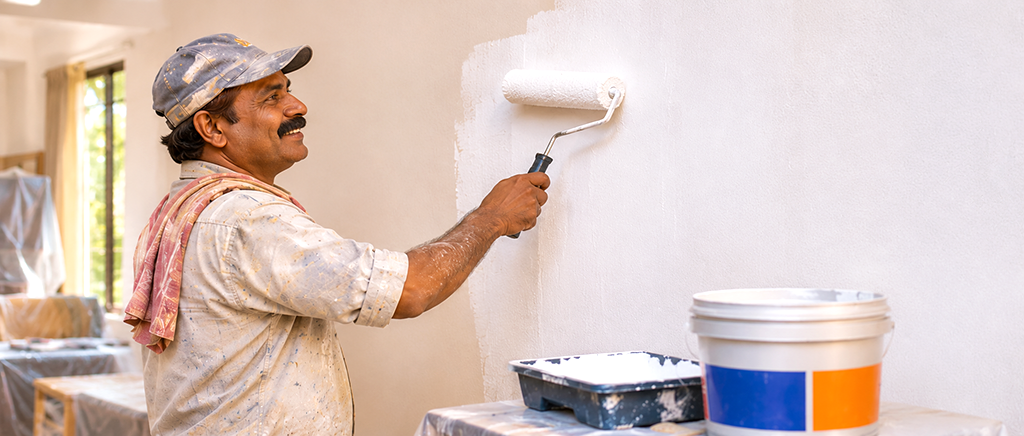
“Primer? Just put two coats of paint, beta, it’s the same thing.” Our old painter in Kanpur told my father that in 2014. Eighteen months later the new pista green in the drawing room had gone pale and blotchy near the skirting. Lesson learnt.
So when we repainted last winter, I made a point of grilling the new painter, Ramesh bhaiya, who has been doing houses in Kanpur for twenty-two years and has strong opinions about everything. Most of this blog is him. I just took notes.
Ramesh calls it “the base coat nobody claps for.” A primer for walls goes on first, usually a plain white or grey coat that most families never even notice going up when they’re busy moving furniture around. Then the colour.
He pressed his thumb on a fresh patch of putty to show me. “Dusty, thirsty wall. Paint goes straight in and disappears.” Primer stops the wall gulping down your first coat of colour like a kid finishing Rasna on a May afternoon.
Obvious question first. Why not just do three coats of paint instead? He laughed for a good ten seconds and then told me about a client in Swaroop Nagar who tried exactly that in 2017 and spent double.
“Paint is for colour. Primer is for holding.” His own example was a sticky note on a dusty fridge, the one that falls off by lunch.
Ground-floor walls get a bonus problem. Ramesh pointed at a white crusty patch near our gate, the kind that looks like someone spilt Surf Excel on the wall and forgot to clean it. Salt from the cement. Primer slows it.
Sometimes. Our guest room was painted in 2021, still smooth, still the same beige we wanted again. Ramesh skipped primer there, finished the whole room in a single long Sunday, and three seasons later it still looks exactly the same.
New plaster is another story. He refuses to skip it on fresh walls, even when a builder in Kalyanpur once offered him an extra ₹2,000 to “save a day.” He said no. Dark-to-light changes need it too (our old maroon study would have ghosted straight through the cream).
Most of what Ramesh uses indoors is a water-based primer for interior walls. Low smell. My mother sat in the next room watching her evening serial the whole time, volume up as usual, and didn’t complain once. Honestly a first.
Outside, Ramesh gets fussier. A primer for exterior walls has to cope with rain hitting it sideways for three months, plus sun hot enough to fry papad on the parapet. He uses an exterior grade, always.
Our old teak door frames got sanded right down to bare wood. Forty years gone. Ramesh used a wood primer before the new coat, muttering under his breath that bare teak knots “always show their face” through enamel otherwise.
The gate got red oxide. That rusty-orange coat is the one everyone recognises from school railings and the old water tank stand on every Kanpur rooftop. In Vizag, he says, skip it and the gate starts rusting by the next season.
Ramesh walked me round a friend’s flat once and spotted it in about four seconds. Shiny bits sat right beside dull bits on the same wall, like a school shirt ironed in a hurry five minutes before the bus. Dead giveaway.
Ghost colours happen too. Peeling near the floor is another tell. Fixing it means scraping everything back to plaster and starting over, and honestly nobody in the house is happy that entire week.
Primer can’t fight a leaking pipe. Our kitchen wall shared plumbing with the neighbour’s bathroom, and the patch kept coming back however many coats went on it. The plumber fixed it first. Then primer.
Usually one. On rough new plaster, or a wall full of patches from the electrician cutting channels for new wiring last summer, Ramesh does two. He decides by flicking water at it.
My uncle in Bhopal does the same trick with a steel tumbler of water, flicking it at the wall like he’s doing aachaman before a puja. Drops soak in fast? Another coat.
On an old, smooth wall going back to the same colour, most painters skip it without any trouble at all. Fresh plaster always needs it. Skipping usually costs more.
Touch-dry in about an hour, says Ramesh, though he waits four to six hours before the first coat of colour goes on top. Monsoon days take longer. Read the tin.
Different jobs entirely. Putty fills the cracks and smooths things out, and primer goes over that once the putty has set and been sanded flat. You’ll need both.