Roof Waterproofing Paint: What Indian Homes Actually Need Before Monsoon
Most Indian homeowners think about their roof twice a year. When it leaks, and when it stops. The window between those two moments is the only useful time to act. Roof waterproofing paint applied before the monsoon works. The same product applied after water has entered the structure is damage control, not prevention.
This blog covers what roof waterproofing actually involves, which products do which jobs, and the sequence that makes the difference between a repair that holds and one that fails by the second monsoon.
Standard exterior emulsion on a rooftop does not constitute waterproofing. Exterior emulsion provides weather protection for vertical surfaces. Walls that face rain but don’t pool water. A rooftop or terrace is a horizontal surface that pools water during monsoon, faces sustained hydrostatic pressure during heavy rainfall, and develops cracks from thermal expansion and contraction across seasons.
Standard paint applied to a rooftop will degrade and lift within one or two monsoon cycles under these conditions. What a roof needs is a dedicated waterproof coating for roof applications. A product specifically formulated to create a seamless, flexible barrier that handles pooling water and substrate movement.
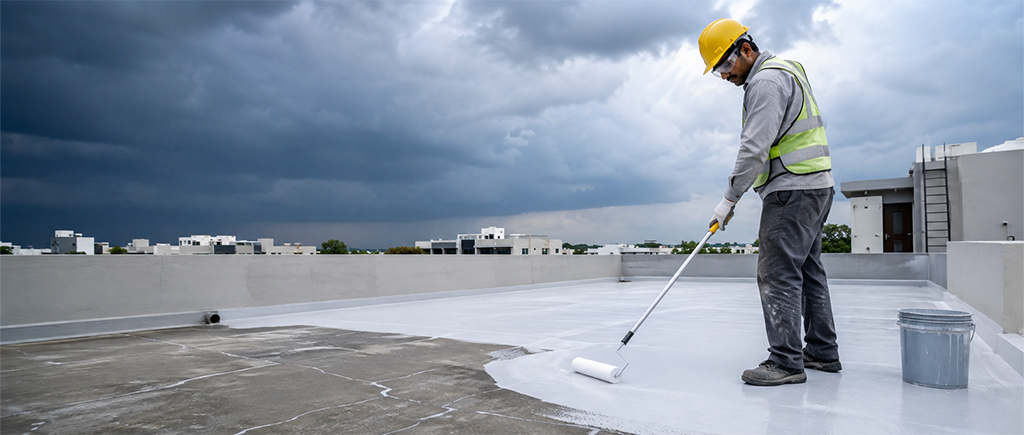
JK Maxx Seal is a waterproofing coating built for rooftops, terraces, and bathrooms. It creates a seamless barrier against dampness, leaks, and sustained rain. On a roof or terrace surface, Maxx Seal builds a continuous flexible membrane. When the substrate moves with temperature changes, the membrane moves with it. The flexibility matters. Rooftop substrates move with temperature changes. A rigid coating cracks at those movement points. A flexible membrane moves with the substrate.
The seamless quality is the key difference between a waterproofing coating and paint. Standard emulsion has a film but that film has gaps, porosity, and weak points at application boundaries. Maxx Seal applied correctly has no gaps. The barrier is continuous across the entire treated surface.
Roof waterproofing is not a single product. It’s a system. Applying Maxx Seal over an unprepared or damaged substrate shortens its life significantly. The correct sequence:
Existing cracks in rooftop plaster or concrete must be repaired before any waterproofing coating goes on. JK Maxx Crack Repair is a premium acrylic modified crack bridging paste for interior and exterior walls. Cracks are the primary entry points for water. Waterproofing over an unrepaired crack creates a surface that looks treated but continues to allow water ingress at the crack point. The coating eventually fails at that point regardless of quality.
For rooftops with RCC concrete slabs, Maxx ILWP, formulated with special additives, makes the concrete more cohesive to prevent water permeability. Maxx ILWP is an integral waterproofing compound. It goes into the concrete mix or onto the concrete surface directly. It makes the material itself resistant to water ingress. The substrate does the work rather than a coating doing it from above.
Maxx PrimeBlock, a uniquely formulated water-based primer consisting of penetrative polymer, is specially designed to enhance the performance of the topcoat. Maxx PrimeBlock penetrates the substrate and gives the Maxx Seal coating something to grip. Without primer, the coating rests on the surface. It hasn’t bonded. Thermal stress and water pressure lift an unbonded coating off the substrate. The waterproofing fails exactly where you need it.
At least two coats of Maxx Seal over the primed surface. The two-coat application creates the thickness required for a durable seamless membrane. Single-coat applications are thinner and more likely to develop pinholes or weak points over time.
Roof waterproofing paint should be applied during dry weather when the substrate temperature is neither too hot nor too cold. The timing makes a larger difference than most people account for. In Indian conditions, this typically means the weeks immediately before the monsoon begins. April to early June in most of the country. Or immediately after the monsoon ends, once surfaces have fully dried out.
Applying waterproofing during or immediately after rain means the substrate is still wet. Waterproofing product applied over a wet substrate doesn’t bond. It looks applied but fails within months. If the surface is damp, wait. Application over a wet substrate bonds poorly and fails early regardless of product quality.
Water stains on ceilings or upper walls: The water is already inside. The source is usually the roof or terrace above. Waterproofing before the next monsoon is the only window that works.
Peeling or bubbling paint on the terrace floor: The existing paint layer has lost adhesion due to moisture in the substrate below it. Painting over it just adds another layer on top of a failing surface. The substrate needs waterproofing treatment.
Visible cracks in rooftop plaster or concrete: Even hairline cracks allow water ingress under the pressure of sustained rainfall. Maxx Crack Repair on visible cracks before any coating application.
Damp patches appearing on external walls near the roof line: Water is tracking from the roof edge or parapet into the wall structure. The parapet walls and roof-wall junctions need specific waterproofing attention.
Efflorescence on interior ceiling surfaces: White crystalline deposits on a ceiling surface indicate moisture is moving through the concrete slab from above. Waterproofing the rooftop surface is typically required.
A minimum of two coats of waterproofing coating like Maxx Seal is recommended for reliable protection. Two coats build the thickness required for a genuinely seamless membrane. Single-coat applications are adequate for maintenance over an already waterproofed surface but not for a new waterproofing job.
The JKPROFIX range covers cement plaster, RCC works, asbestos sheets, and cement sand renderings as application surfaces. Maxx Seal and associated products are formulated for all standard Indian roofing substrates.
Applied correctly over a properly prepared substrate, good quality waterproofing coating should perform reliably for 8-10 years before reapplication is needed. Surface application without proper substrate preparation can fail within 2-3 monsoon cycles. The preparation sequence, crack repair, admixture treatment, primer, then coating, is what determines longevity rather than the coating product alone.
Small terrace areas with accessible surfaces can be handled by a competent person following the product application guidelines. Larger rooftop areas, areas with significant structural cracking, or roofs showing advanced water damage are better handled by a professional applicator who can assess the substrate condition and apply the system correctly.