Indian Simple House Colour Combination Outside: What Works on Indian Exteriors
The outside of an Indian home faces conditions that most exterior paint guides written for other markets don’t account for. Monsoon rain, intense UV from a subtropical sun, summer temperatures that push exterior wall surfaces to 60°C and above, dust accumulation in dry months, and humidity cycles that stress the paint film repeatedly through the year. The colour combination you choose needs to handle all of this. If it doesn’t, no amount of good taste in the choice makes up for the failure.
This guide covers the most effective colour combinations for Indian home exteriors, organised by the type of home and the look you’re going for, with specific shade guidance from the JK Maxx Armour range which is engineered specifically for Indian exterior conditions.
Two decisions shape the outcome before you’ve looked at a single colour.
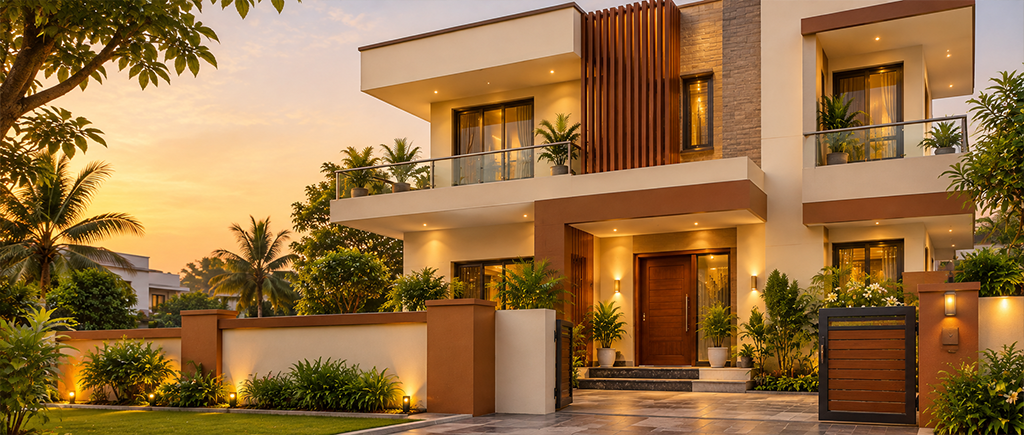
The most consistently successful Indian house exterior palette. Warm off-white on the main facade, not stark cool white but a sandy, slightly warm version, with a deeper earthy tone on the boundary wall, window frames, and architectural details. Warm off-white reflects solar heat. The wall surface stays cooler. The earthy trim provides definition.
JK Maxx Armour shades: Sandy off-white on the main facade, Cornbread or Caramel Kiss on the trim and boundary wall. Armour Dust Protec on the main facade. The Dust Shield Technology keeps dust from settling on the light surface and Therma-Guard keeps the wall up to 7°C cooler.
Cream and brown create a warm, welcoming exterior. The combination works in urban and rural settings equally. On an Indian home, the versions that work in India: warm sandy cream on the main walls, warm chocolate or teak-brown on the plinth, cornices, and window surrounds. This is a combination that improves with age. Both colours become more settled rather than looking tired as years pass.
Particularly suited to traditional Indian homes, independent houses with compound walls, and homes in warmer climates where the palette agrees with the surroundings.
Peach and white are two colours that go together naturally. Peach is a muted colour that, when used properly, makes a home look classy. White accents give a break from the larger surface area of peach.
In Indian conditions, the peach needs to be warm and slightly earthy rather than the cool, pinkish peach that works in cooler climates. Warm terracotta-adjacent peach alongside warm white or cream trim. Under Indian sunlight, this combination develops a richness that photographs well and reads well from a distance.
For the outside colour of a simple Indian house, the combination of blue and white creates an eye-pleasing appearance. Blue settles the facade. White freshens it. The combination suits contemporary Indian homes.
The specific blue matters. Mid-tone, slightly warm blues work better on Indian exteriors than cool slate blues. April Sky or Faraway Sky from JK Maxx at the lighter end, Cove Blue at mid-depth. White on the main facade, blue on the boundary wall, gate, and details. Or blue on the main facade with white trim. Works for contemporary homes with flat facades in areas where the building is set back from a garden.
The most specifically Indian of the exterior palettes. Warm sandy cream on the upper facade, terracotta or Rustique from JK Maxx on the plinth and lower sections. The terracotta references Indian brick and earthwork traditions. The sand above lightens the combination and keeps the home from looking dark.
Peach and terracotta combinations with shades that bring warmth and vibrancy reflect Indian architectural roots and look rich even in strong sunlight. This is the combination that looks most naturally rooted in the Indian built environment.
For contemporary Indian homes, apartment buildings, modern independent houses, urban bungalows, warm grey on the main facade with white on the architectural elements, window frames, and balcony railings creates a graphic, modern quality. The grey needs to be warm (beige-undertoned) rather than cool. Cool grey on an Indian exterior under warm Indian sunlight can look slightly greenish.
Chamois or Smokeytone from JK Maxx for the warm grey. White or warm off-white on trim and detail elements. Armour Dust Protec in the grey shades. Dust shows less on grey than on white but the Dust Shield Technology still matters over 5-6 years.
Warm earthy palettes. Cream, terracotta, warm yellow, warm peach. Natural material accents at the stone plinth, brick detailing, and wooden elements. These homes need colours that read as part of the landscape, not set against it.
Red and gold on Indian home exteriors carries specific cultural meaning. The combination is associated with abundance and is a traditional choice in village and festival contexts. For village homes specifically, a warm red-terracotta on the lower section with warm cream or yellow above is both traditional and practical.
More architectural complexity. Compound gates, garden walls, balconies, entrance canopies. These homes can carry two or three colour decisions. Main facade in warm off-white or sandy cream, boundary wall in a deeper earthy tone or warm grey, gate and metalwork in near-black or dark charcoal.
A single colour across the main facade with white or near-white on the balcony railings and window frames. The scale of an apartment block means a bold colour decision on the whole facade reads very differently than it does on a single independent home. Warm, mid-tone colours, warm greige, sandy terracotta, dusty peach, are the most practical for apartment exteriors.
Indian exterior paint faces a problem that most other markets don’t. Dust. Fine particulate dust settles on exterior paint surfaces and makes light colours look dirty within weeks of painting. Armour Dust Protec from JK Maxx addresses this directly with Dust Shield Technology that reduces dust adhesion on the exterior surface.
Light exterior colours, cream, warm off-white, sandy peach, stay cleaner for longer. The Therma-Guard technology in Armour Dust Protec keeps the wall surface up to 7°C cooler than standard exterior paint, which matters for the longevity of the paint film in Indian summer conditions.
Warm off-white, cream, and sandy beige are the most widely used exterior colours for Indian homes. They handle Indian sunlight, accumulate less visible dust than stark white, and suit the widest range of architectural styles. JK Maxx Armour Dust Protec in warm off-white is the practical choice for Indian home exteriors that need to stay clean through the dry months.
One colour on the main facade. A contrasting second colour on the plinth, boundary wall, trim, and gate. This is the most common and most successful approach. The main facade colour should be lighter and the accent colour darker. Equal amounts of two colours on an exterior can create visual confusion.
Exterior emulsion or exterior texture. Not interior paint. Interior paint on an exterior wall will peel within one monsoon cycle. For main facade walls, Armour Dust Protec from JK Maxx is the premium choice. For textured exterior effects, Patternz or Patternz RockTex from JK Maxx creates textured facades with the same weather resistance.