How to Choose a Front Door Colour: A Practical Guide for Indian Homes
The front door is what a visitor reads before they’ve stepped inside. In Indian homes, it’s also one of the most visible surfaces because most Indian homes have a compound gate, an entrance path, and then the front door. Three separate elements a visitor walks through sequentially. The front door colour needs to work with all of them.
Most front door colour advice is written for Western homes where the front door is the only element at the street-facing level. In Indian homes the calculation is different.
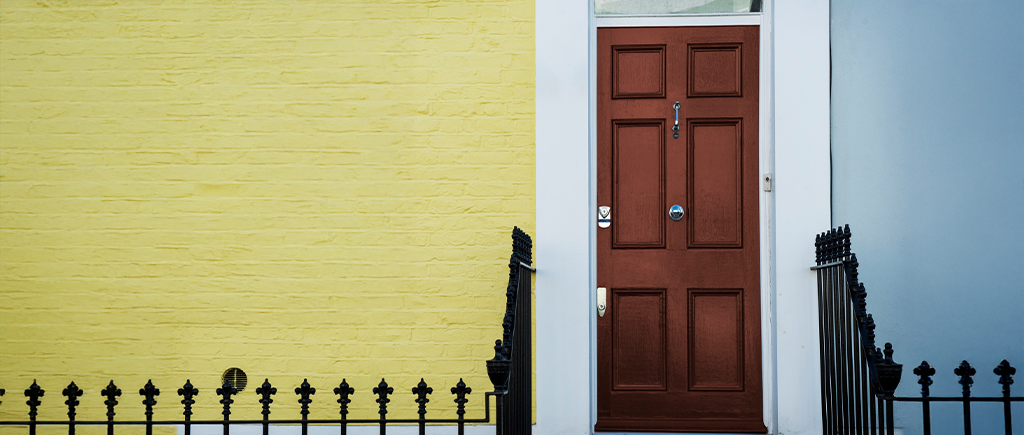
The front door colour needs to contrast with the exterior wall or complement it. It can’t fight it. A dark door against a very dark exterior wall disappears. A very bright door against a pale exterior wall can work but needs to be the right bright.
The most reliable approach: go significantly darker or significantly lighter than the exterior wall, or pick a colour from a completely different family. Warm terracotta exterior wall with a dark teak stain on the door. Warm off-white exterior wall: deep navy or forest green on the door. Pale grey exterior: glossy black door.
Timber doors and metal doors behave differently with paint. Timber doors, teak, mango wood, sheesham, can take wood stains, wood finishes, and enamel paint. Indian timber grain and warmth are worth preserving. Solid colour covers what makes the door worth looking at. Metal doors need enamel paint specifically formulated for metal, with appropriate metal primer underneath.
Front doors in direct afternoon sun on south or west-facing elevations take significant UV and thermal stress. Dark colours on south or west-facing front doors fade faster and can cause excessive heat in the door material itself. Light to mid-tone colours are more practical on high-sun elevations. On shaded or north-facing elevations, darker colours are more viable.
Traditional Indian architecture, haveli-influenced, vernacular, brick construction, tends to handle warm colours well. Deep terracotta, warm red, traditional Indian reds. Contemporary Indian architecture, flat facades, clean lines, minimal detail, handles stronger colour decisions. Deep navy, forest green, or glossy black on the door.
The compound gate, the boundary wall, the entrance flooring, any visible metalwork. The door colour needs to be a decision within this composition rather than a decision about just the door. A bold red door against a charcoal gate and warm stone entrance flooring looks deliberate. The same bold red door against a white gate and pale beige flooring looks like different decisions placed next to each other.
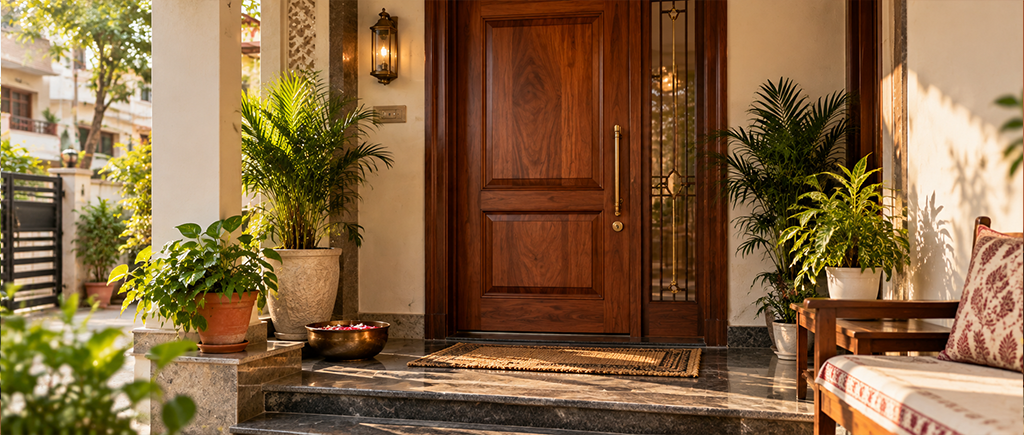
The richest appearance on an Indian timber front door is a wood stain or natural finish that lets the grain show. Teak, sheesham, and mango wood all have visible grain and natural warmth that a solid paint colour covers. JK Maxx wood finish products cover this application: the natural finish range preserves and enhances the timber quality while providing protection.
For timber doors that have been previously painted, or where a solid colour is specified, synthetic enamel is the product for this application. Choosing the right paint colour for wooden door surfaces means considering the door’s exposure. South and west-facing doors in direct afternoon sun need lighter shades that handle UV better than deep colours. Enamel on timber cures hard and glossy. It resists weathering and holds its colour through Indian seasonal cycles. The glossy finish on a front door reads as intentional in a way matte finishes don’t.
On Indian front doors in solid enamel, deep navy, forest green, dark charcoal, warm red, rich burgundy, and glossy black all hold up and look right against Indian exterior contexts. All of these hold up in gloss enamel and look right against Indian exterior contexts. JK Maxx Enamelo Synthetic Enamel covers this application.
Metallic paint for wood is a finish choice rather than a colour choice. It gives the surface a sheen that reads as bronze, copper, gold, or silver depending on the formulation, and is applied over a sealed or primed timber surface.
In Indian home exteriors, metallic paint for wood on front doors appears most often as:
Bronze or copper finish: The warm end. Heritage quality. Works alongside brass and warm timber. Common on traditional and neoclassical Indian homes. Reads as deliberate and appropriate against warm stone or terracotta.
Gold accent finish: On door panels, mouldings, or door frame details rather than the whole door. Used as an accent within a darker base colour.
Charcoal or graphite metallic: Contemporary Indian exterior aesthetic. The metallic quality is subtle. The door reads as charcoal but with a depth that flat charcoal doesn’t have. This is a good option for contemporary Indian homes where a dark door is specified.
Metallic paint for wood requires good surface preparation before application. Filling, sanding, and sealing. The metallic finish catches light. Surface imperfections show up clearly. Application over an unsound or poorly prepared surface will show every defect.
Front door paint fails most commonly because of inadequate preparation rather than inadequate product. The door takes significant environmental stress. Rain, heat, UV, repeated contact. Paint system weaknesses become visible within 12-18 months on a front door.
Timber doors: Sand back loose or failing paint. Fill cracks and gaps with wood filler. Apply exterior-grade wood primer before the finish coat. Exterior-grade wood primer is necessary, not interior primer.
Metal doors: Remove rust completely. Clean with a degreaser. Apply metal primer with rust-inhibiting properties. Two coats of enamel topcoat over the primed surface.
Existing painted surfaces in good condition: Lightly sand to break the gloss, wipe clean, apply one primer coat, then one or two finish coats.
Deep red, warm terracotta, or a rich burgundy in gloss enamel. These colours sit naturally in Indian design tradition and agree with the typical materials of traditional Indian exteriors. Stone, brick, teak, and warm plaster.
Not match, but coordinate. The gate and the front door are part of the same first impression. Both warm or both cool. A dark gate with a dark door looks intentional. A dark gate with a light door works if the light door is genuinely light. A gate in one warmth direction and a door in the opposite creates tension at the entrance that visitors notice without being able to name.
On a properly prepared, primed, and painted surface, exterior enamel on a front door should hold for 4-6 years before repainting is required. High-sun south and west-facing doors will be at the lower end of that range. Shaded north-facing doors at the higher end. Touch up any chips or cracks as they appear. Chips and cracks let moisture in and the deterioration accelerates from there.