Beige Colour Combination for Walls: What Pairs Well and Why in Indian Homes
Beige is the colour most people choose and then second-guess. The doubt usually comes from picking a beige without understanding its undertone and watching it behave unexpectedly at 8pm. Get the undertone right and beige is the most useful base colour available for Indian home walls. Get it wrong and the room looks unfinished.
Beige works as a base colour because it accepts most pairings without argument. The combinations below cover what actually works in Indian home conditions: which pairings read as warm and considered, which are appropriate for which rooms, and which JK Maxx shades cover each combination.
Not all beige shades behave the same way. Identify the undertone of the specific beige before choosing a combination.
Yellow-beige: Honey Cream, Egg Custard, Vanilla Custard from JK Maxx. Under warm Indian evening LEDs, these go more golden. In rooms with flat indirect light, the yellow warmth compensates for what the light doesn’t provide. Good for north-facing rooms and rooms used primarily in the evening.
Sandy-beige: Morocco Sand, Old Linen, Flax Straw from JK Maxx. More brown in the base, less yellow. These read as earthy and natural rather than warm-cream. The most forgiving beige group across all Indian home lighting conditions.
Greige: Chamois, Sesame from JK Maxx. Beige with grey in the base. These read as contemporary neutral. Under warm evening LEDs, the warmth comes forward and the grey recedes. For modern Indian apartments where warmth is wanted without a traditional quality.
The undertone determines which accent colours work alongside. Yellow-beige pairs well with warm terracotta, warm red, and dark timber. Sandy-beige pairs well with almost everything. Greige pairs well with darker greys, teal, and deep blue.
The most widely used and most forgiving beige colour combination. Warm beige on the main walls, warm white on the ceiling and trim. The key word is warm. Both colours need to be warm-toned. Stark cool white alongside warm sandy beige creates undertone tension that neither colour can resolve.
Navajo White or Paper Moon from JK Maxx on the ceiling and trim, Morocco Sand or Old Linen on the walls. This combination reflects light back into the room and keeps the space feeling open. It accepts any furniture style. Under warm Indian evening LEDs, the beige goes slightly more golden and the warm white ceiling glows. The room reads as settled by evening.
The contemporary beige combination. Sand beige on three walls, warm grey on the feature wall. Or all-room greige, Chamois from JK Maxx, with a deeper warm grey on the feature wall.
The grey needs to be warm-undertoned rather than cool. Cool grey alongside warm beige creates a colour temperature mismatch that becomes more obvious under warm evening lighting. Chamois or Smokeytone from JK Maxx for the grey section. The combination reads as modern and composed without the coldness that all-grey rooms can have.
Warm beige on three walls, deep teal or forest green on the feature wall. The contrast is high. The warm neutral of beige and the cool-organic quality of deep teal are in different temperature families. The pairing works because neither colour is aggressive. Beige is the warmth and teal provides the freshness and character.
Morocco Sand or Old Linen from JK Maxx on three walls, Stormy Blue or Cove Blue (in the teal direction) or Herbal Garden or Sherwood Forest (in the green direction) on the feature wall. Dark teak furniture, brass fixtures, natural linen. The combination has a specific quality that most Indian rooms don’t achieve: it feels both warm and fresh simultaneously.
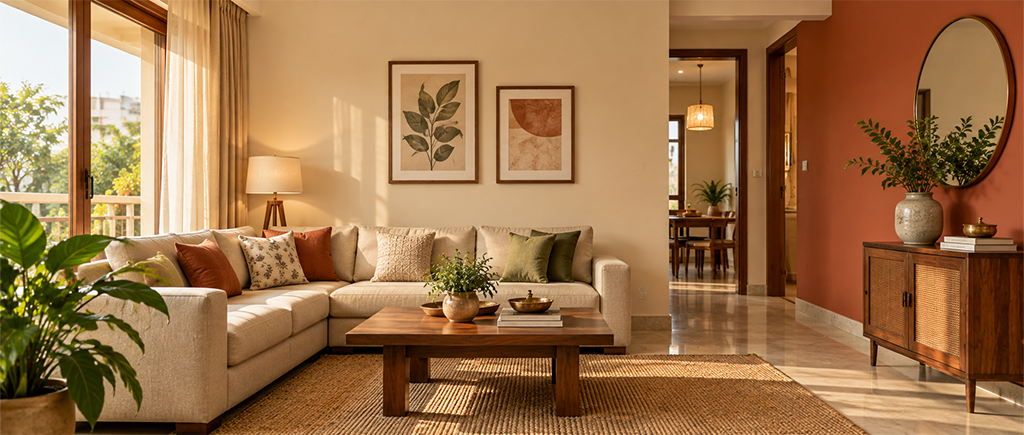
The most specifically Indian beige colour combination. Sandy beige on three walls, warm terracotta or brick red on the feature wall. Both colours are earthy and warm, and they share the same warmth family. The combination looks most natural in Indian homes because the terracotta references Indian material traditions, clay, brick, earthwork, and the beige echoes the sandy, warm quality of Indian stone.
Morocco Sand on three walls, Antique Brick or Rustique from JK Maxx on the feature wall. Dark teak furniture, brass or copper fixtures, jute textiles. Under warm evening LEDs, both colours deepen and the room goes genuinely warm and atmospheric.
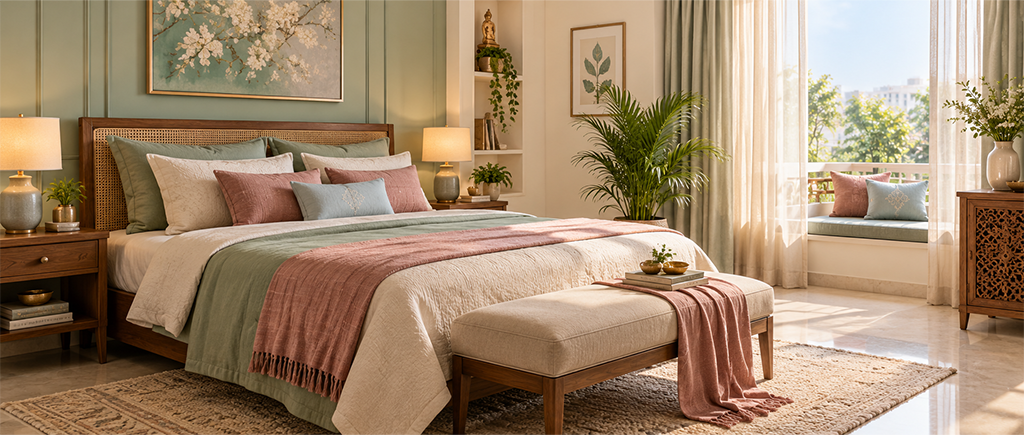
Warm beige on three walls, dusty pink or muted mauve on the feature wall. This is the beige combination for bedrooms specifically. The warmth of beige and the softness of dusty pink are in the same warmth family. Neither colour is demanding. The combination creates a bedroom that reads as warm, considered, and restful without any single decision standing out.
Chamois or Old Linen from JK Maxx on three walls, Heather Mist or Rose Ash from JK Maxx on the feature wall. Warm linen curtains, dark teak bed frame, brass bedside lamps. Under warm evening LEDs, the dusty pink goes slightly more golden-pink and the beige settles. The room becomes more intimate in the evening.
Warm beige on the walls, dark charcoal or near-black in the furniture, frames, and fixtures. This is the combination that reads as architecturally sophisticated rather than simply warm. The dark elements create crispness and definition against the beige ground. A black metal lamp, dark timber shelving, charcoal-framed artwork against beige walls reads as considered and deliberate.
Morocco Sand or Old Linen from JK Maxx on the walls, Iron Ore or Gunmetal from JK Maxx if any wall element is being darkened. The contrast between warm beige and dark charcoal doesn’t date. It looks right across traditional, contemporary, and mixed interior styles.
Living room: Sandy-beige on all four walls or three walls with a terracotta or teal feature wall. Morocco Sand or Old Linen from JK Maxx.
Bedroom: Yellow-beige or sandy-beige on the walls, dusty pink or warm grey as the feature wall. Honey Cream or Chamois from JK Maxx. The undertone should be warm enough that the room feels inhabited after dark.
Kitchen: Try a warm sandy beige like JK Maxx Morocco Sand or Old Linen. It works well with white tiles, handles kitchen marks better than white, and looks warm without feeling too yellow. Go for a satin or semi-gloss finish.
Hallway: Sandy or yellow-beige on the walls with warm timber flooring and brass fixtures. The warmth of beige compensates for the flat light that most hallways receive all day. Morocco Sand or Honey Cream from JK Maxx.
Warm terracotta or brick red for the most specifically Indian character. Warm grey for a modern, composed quality. Teal or deep green for freshness and contrast. Dusty pink or mauve for bedrooms. Dark charcoal in the furniture and fixtures for sophistication. Of all these, warm terracotta alongside sandy beige, Antique Brick or Rustique from JK Maxx alongside Morocco Sand or Old Linen, is the combination that reads most naturally in Indian home conditions.
Yes, when the grey is warm-undertoned. Chamois and Smokeytone from JK Maxx are warm greys that sit naturally with sandy beige. Cool grey alongside warm beige creates a temperature mismatch. Under warm Indian evening LEDs, the cool grey goes slightly greenish while the warm beige goes more golden. The combination becomes less comfortable the longer you spend in the room.
Cream has more yellow in the base and reads as clearly warm from a distance. Beige has brown or grey alongside the yellow and reads as a warm neutral with more depth. On a wall, cream reads as softer and more obviously warm; beige reads as more settled and neutral. Both work in Indian home conditions.